


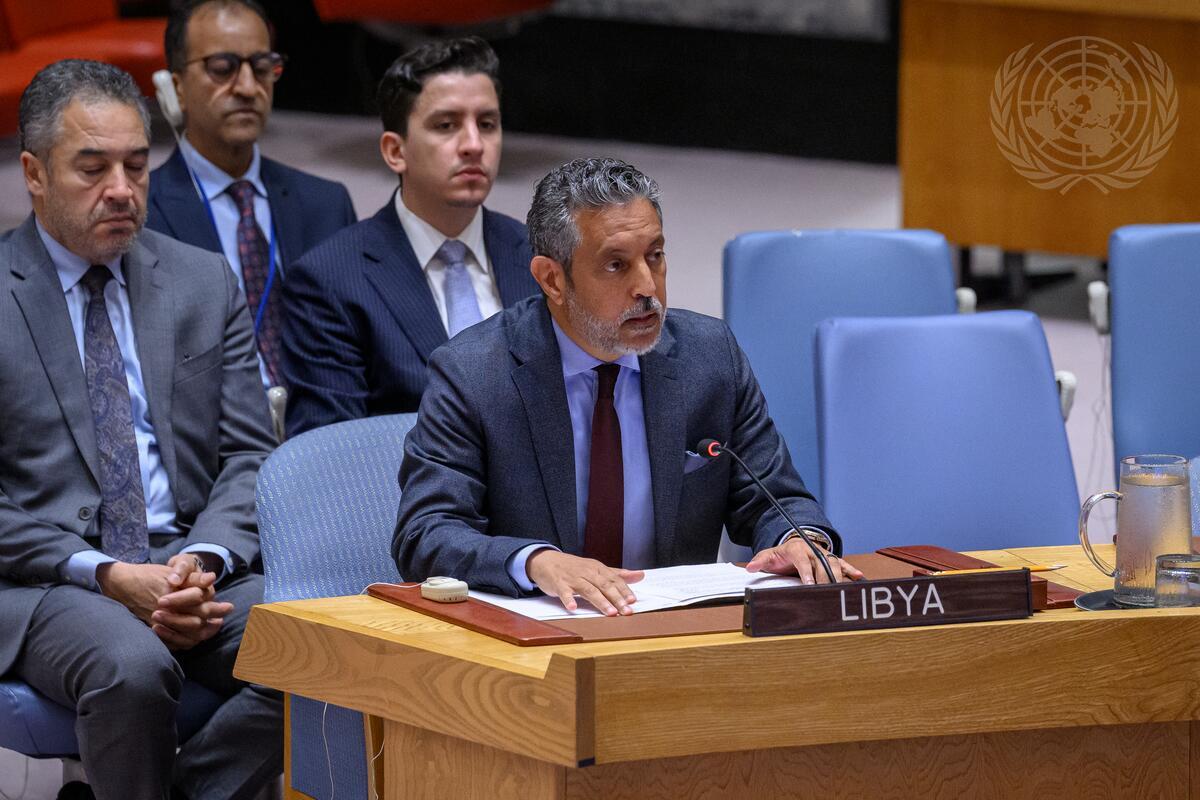

New York — June 18, 2026
United Nations Security Council Briefing on the Situations in Libya
Unofficial Translation
Libya Statement
H.E. Ambassador Taher M. El-Sonni, Permanent Representative of the State of Libya to the United Nations
Mr. President,
At the outset, I congratulate you on assuming the presidency of the Council this month, and I thank Ms. Hanna Tetteh for her briefing, which we have taken note of.
Ladies and Gentlemen,
At the beginning, we must commend the sincere national efforts of all participants in the “Structured Dialogue,” who have continued their tireless work over the past six months, driven by a genuine desire to produce practical outcomes offered as qualitative solutions and approaches to the current Libyan crisis across its various tracks, despite the challenges and the multiplicity of initiatives and scenarios presented.
Alongside these sincere efforts, it is necessary to point out and convey what has been observed by many: that some outcomes of this dialogue turned out contrary to what the UN Mission had initially presented—namely, that this dialogue would address state-building issues and tackle the root causes of the dispute. It is also our duty to convey reservations regarding the methodology by which the sessions were conducted, which appeared biased toward including a specific viewpoint while neglecting several other opinions without clarifying the reasons.
Therefore, we had hoped that the final report would reflect all differing opinions, particularly those expressing the orientations of a broad spectrum of the Libyan people, ensuring a balanced representation of various national visions.
For instance, the report included a blueprint for a new transitional phase and overlooked the viewpoints within the dialogue that call for direct and comprehensive elections, or any reference to the completed draft constitution, despite both being among the most critical national prerequisites for ending division and instability.
Thus, judging the success of the ongoing efforts and dialogues places us today before fundamental questions and urgent imperatives that require answers in this regard:
First: Do these outcomes represent a practical and true consensus formula that reflects everyone’s aspirations?
Second: What are the executive mechanisms capable of implementing these proposals on the ground? Is there a link between them and previous dialogues, such as the recommendations of the Advisory Committee and its outcomes last year? And how can they be built upon? Or are they entirely separate tracks?
Third: How will the divergence and differing viewpoints expressed by some participants in the Structured Dialogue be handled and addressed constructively, particularly what occurred within the Governance Track as Ms. Tetteh mentioned today, as well as with a group of women representatives?
Fourth, and most importantly: How can these outcomes be utilized and invested as a primary asset that supports the overall political track?
These are questions that must be noted and taken into consideration, and clear, fully transparent answers must be provided to the Libyan people.
In this framework, it is important to build upon the progress made within the “4+4” Committee to reach consensus on restructuring the Board of the High National Elections Commission (HNEC), which will enhance the prospects of holding general elections to renew the legitimacy of authorities. It is also vital to support the consensus reached regarding decoupling the legislative and presidential elections and arriving at an agreement on the legislative elections law, which represents a significant precedent in the course of the Libyan political dialogue spanning the past ten years.
This consensus comes as an extension of the agreement achieved to unify the state’s general budget for the first time in over thirteen years, thereby strengthening fiscal discipline, rationalizing public spending, and supporting economic recovery; on this occasion, we emphasize the importance of implementing the agreement reached therein.
Furthermore, and as noted in a number of your statements today, we took note of the document of common principles between the Presidencies of the House of Representatives, the High Council of State, and the Presidential Council concerning understandings to complete the constitutional and legal framework for elections, and its efforts to reinforce the unity of sovereign institutions to pave the way for holding elections and ending institutional division.
Ladies and Gentlemen,
The aforementioned initiatives and tracks confirm that sustainable solutions in Libya stem from dialogue and consensus among national institutions in a manner that respects national ownership of the political process; from this podium, we call upon you to support them.
Hence, we would like to reaffirm the unwavering principles from which there can be no deviation to ensure the success of any political track:
-
The immediate conclusion of all transitional phases.
-
The drafting of applicable electoral laws and a constitutional basis that guarantees the integrity of the political process.
-
Learning from past experiences and avoiding the repetition of their mistakes.
-
Engaging with effective actors and rejecting exclusion or marginalization.
-
Full commitment to relevant Security Council resolutions and the political agreements resulting from them.
Based on the foregoing, we call upon you to support national initiatives grounded in these concepts, and we reiterate our welcome of all international efforts that contribute positively to forging practical solutions and constructive consensus, ensuring support for the national will and respect for Libyan leadership of the solution.
Ladies and Gentlemen,
We warn once again that the continuation of this vicious cycle and political impasse will lead to new crises and bottlenecks, which some parties might exploit to advance suspicious foreign agendas that do not only target the stability of Libya but threaten the security and stability of the entire region.
In this framework, the Government continues to work on extending state authority and strengthening its security and military institutions, which has contributed to maintaining security and stability, pursuing outlaws, and exposing entities that support riots and violence.
Among these crises is the issue of irregular migration and the events that followed during the recent period. While we value the peaceful expression of positions regarding this issue and its repercussions, we find it strange that some parties exploit it for narrow political gains by inciting the public and spreading disinformation.
We assure everyone that Libya will not be a land for the resettlement of migrants in any form whatsoever, and that it continues to work with the international community to address this phenomenon, just as efforts have culminated in the launch of a quadrilateral mechanism comprising Libya, Italy, Turkey, and Qatar to establish practical and radical solutions for this phenomenon.
In this regard, we point out that a true and radical approach to confronting this phenomenon begins with dismantling and eliminating transnational criminal networks that traffic in human suffering, and considering this a top priority for all countries affected by this phenomenon, whether countries of origin, transit, or destination.
As we speak about the importance of prosecuting and punishing human smugglers and their networks, we reaffirm the importance of prosecuting and punishing those involved in oil smuggling crimes, which we have pointed out on several occasions. They are no less dangerous, as plundering the livelihood and wealth of Libyans and exploiting the current situation contributes to funding these criminal networks and others.
In conclusion, despite the challenges and the national responsibility placed upon our shoulders to convey to you the voice of the Libyan people of all orientations and affiliations, the positive and promising aspects witnessed during this stage must not be overlooked. We are seeing a broad and encouraging engagement from various segments of Libyan society—including national leaders, political elites, and civil society organizations—in active discussions and dialogues. This societal mobilization clearly demonstrates the awareness of the Libyan people and their genuine and urgent desire to forge peaceful, national solutions, moving completely away from the language of confrontation and armed conflict. Therefore, we call upon this Council and the international community to seize this opportunity and support the Libyan people for the stability of the country and to build international partnerships based on parity and respect for national sovereignty.