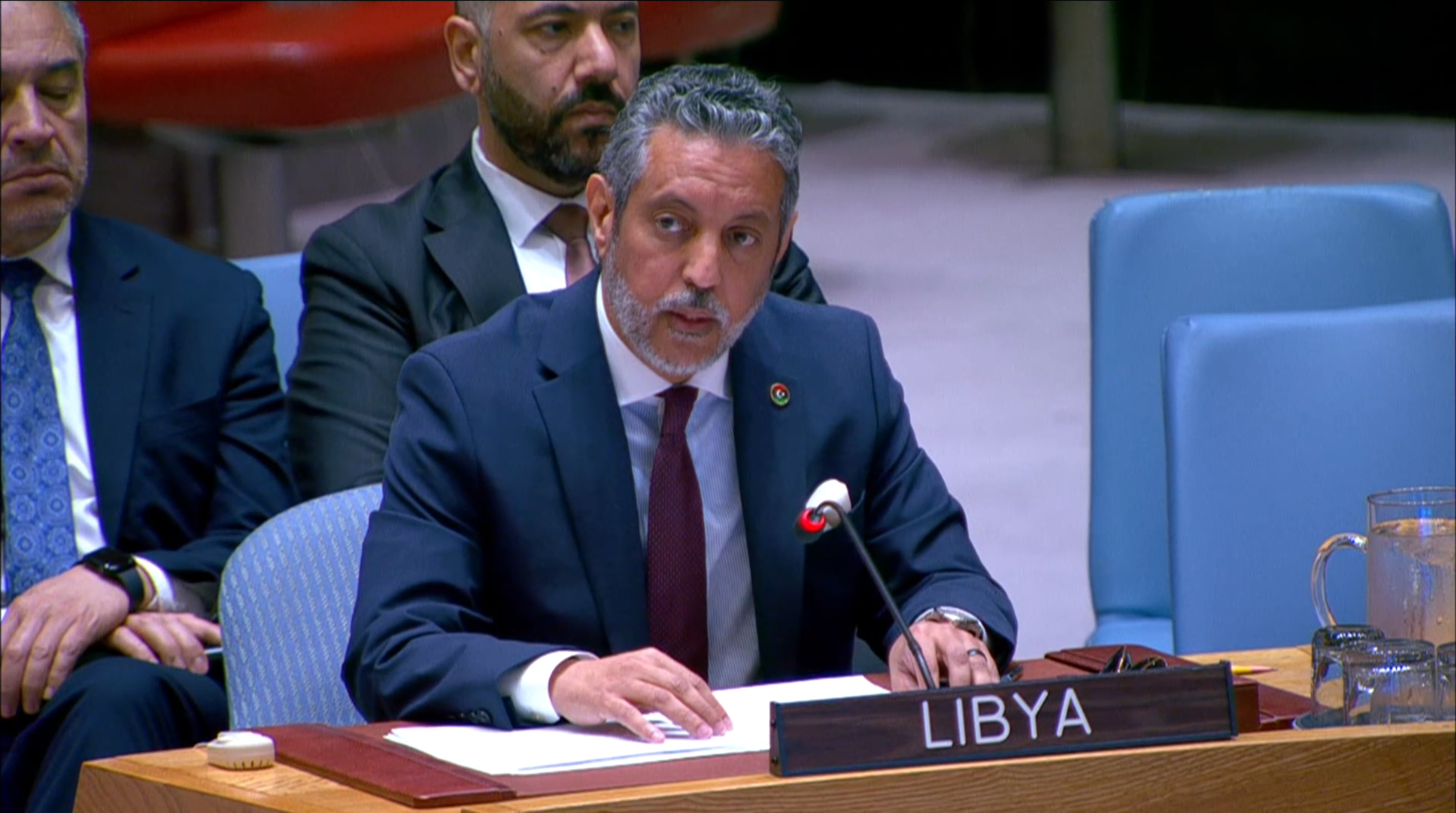

New York — May 22, 2026
United Nations Security Council Briefing bt the International Criminal Court on the Situations in Libya
Unofficial Translation
Libya Statement
H.E. Ambassador Taher M. El-Sonni, Permanent Representative of the State of Libya to the United Nations
Mr. President,
At the outset of my statement, I have been requested to convey to you, Madam Nazhat Khan, and to your accompanying delegation, the appreciation and gratitude of the Prime Minister of the Government of National Unity, Mr. Abdul Hamid Dbeibah, for your efforts. I quote him here:
“I reiterate the Council of Ministers’ commitment to close cooperation under Article 12(3) regarding the expansion of investigative powers and the extension of the mandate until the end of 2027. This has been significantly reflected in the promotion of human rights across the entirety of Libyan territory without exception. Every violator of the rights of the vulnerable, and every criminal entrenched in perceived inability or unwillingness, now thinks dozens of times before crossing the boundaries of his own humanity and that of his victims.”
I also quote the Prime Minister once again:
“The Council of Ministers is working diligently to dismantle armed groups operating outside state authority, ensure non-impunity, and strengthen the performance of state institutions that respect the dignity of citizens and are committed to the law and accountability. We also condemn all crimes of killing, torture, and enforced disappearance committed over the past years, and we will spare no effort in holding those responsible accountable, ensuring a better and secure future for our children and generations to come.” End of quote.
Ladies and Gentlemen,
While expanding cooperation between the Court and Libyan authorities to elevate human rights standards and combat impunity, we emphasize the vital importance of prosecuting perpetrators of war crimes, crimes against humanity, and genocide. This must take place within a framework of judicial complementarity and burden-sharing with the national judiciary, thereby strengthening the rule of law, human rights, and ending impunity in partnership with Libyan institutions.
We reaffirm that expanding cooperation until the end of 2027 reinforces the Court’s jurisdiction based on its foundational principle: complementarity, not substitution. The Libyan national judiciary holds original and primary jurisdiction, given the presence of both the ability and the willingness to activate judicial complementarity. The Court’s role remains supported through cooperation and the exchange of evidence when national proceedings face impediments or when pursuing wanted individuals.
Furthermore, my country affirms, within the framework of its commitment to the declaration based on Article 12(3), that any unlawful acts or practices that may be committed by certain state employees represent isolated, individual conduct. They do not reflect the policy, institutions, or official orientation of the State. Responsibility for such acts remains strictly personal to the perpetrators, without creating any liability for the State to pay compensation arising from these actions.
Ladies and Gentlemen,
In this context, it is essential to commend the efforts of the Attorney General’s Office regarding the Tarhuna mass graves file, through the investigation of hundreds of cases and the issuance of arrest warrants against suspects. We call upon the Court to exert pressure to apprehend suspects currently outside the country, particularly within member states that are signatories to the Rome Statute, to secure their arrest and surrender without any delay. To date, this file remains one of the greatest atrocities committed in Libya, and regrettably, it was mentioned today by only three countries.
I would also like to address Libya’s efforts in combating human trafficking and migrant smuggling. This has been done by bringing forward multiple cases, detaining suspects of various nationalities, and launching a national and international initiative by the Government in 2024 with the participation of UN and international organizations to address this phenomenon and enhance cooperation.
We reiterate that any individual violations do not represent state policy, while emphasizing our rejection of impunity for criminals and our support for building a state based on institutions and the rule of law. We emphasize that these crimes are not subject to a statute of limitations, and that the national judicial system enjoys full support and confidence despite real challenges and difficulties.
Consequently, we call for strengthening the principle of complementarity and maintaining communication channels through established diplomatic avenues. We seize the opportunity of this session to draw the Council’s attention to what the latest report has revealed regarding the growing activity of transnational organized crime networks and human trafficking. This is in addition to what was stated in the Panel of Experts’ report last month regarding the escalation of fuel smuggling—a practice that represents a systematic tampering with the resources and sovereign wealth of the Libyan people, and contributes to financing destabilizing activities.
In this regard, we request the Council to take into consideration the technical and procedural observations raised by the National Oil Corporation (NOC) regarding certain elements of the report, particularly concerning the data verification methodology, mechanisms for attributing responsibility, and the accuracy of certain conclusions related to export movements and operational processes.
We also renew our call to the Council to support efforts aimed at imposing sanctions on the actual perpetrators, dismantling criminal networks and syndicates, and transitioning from the phase of monitoring and documentation to concrete action based on rigorous verification of facts and evidence. This will ensure that everyone proven to be involved is held accountable and does not escape justice, utilizing the tools and mechanisms available to the Council.
Ladies and Gentlemen,
In short, all that the Libyan people aspire to is the establishment of justice and the building of a state of institutions and the rule of law. If you can, be a help to them; and if you cannot, do not be a burden upon them.