


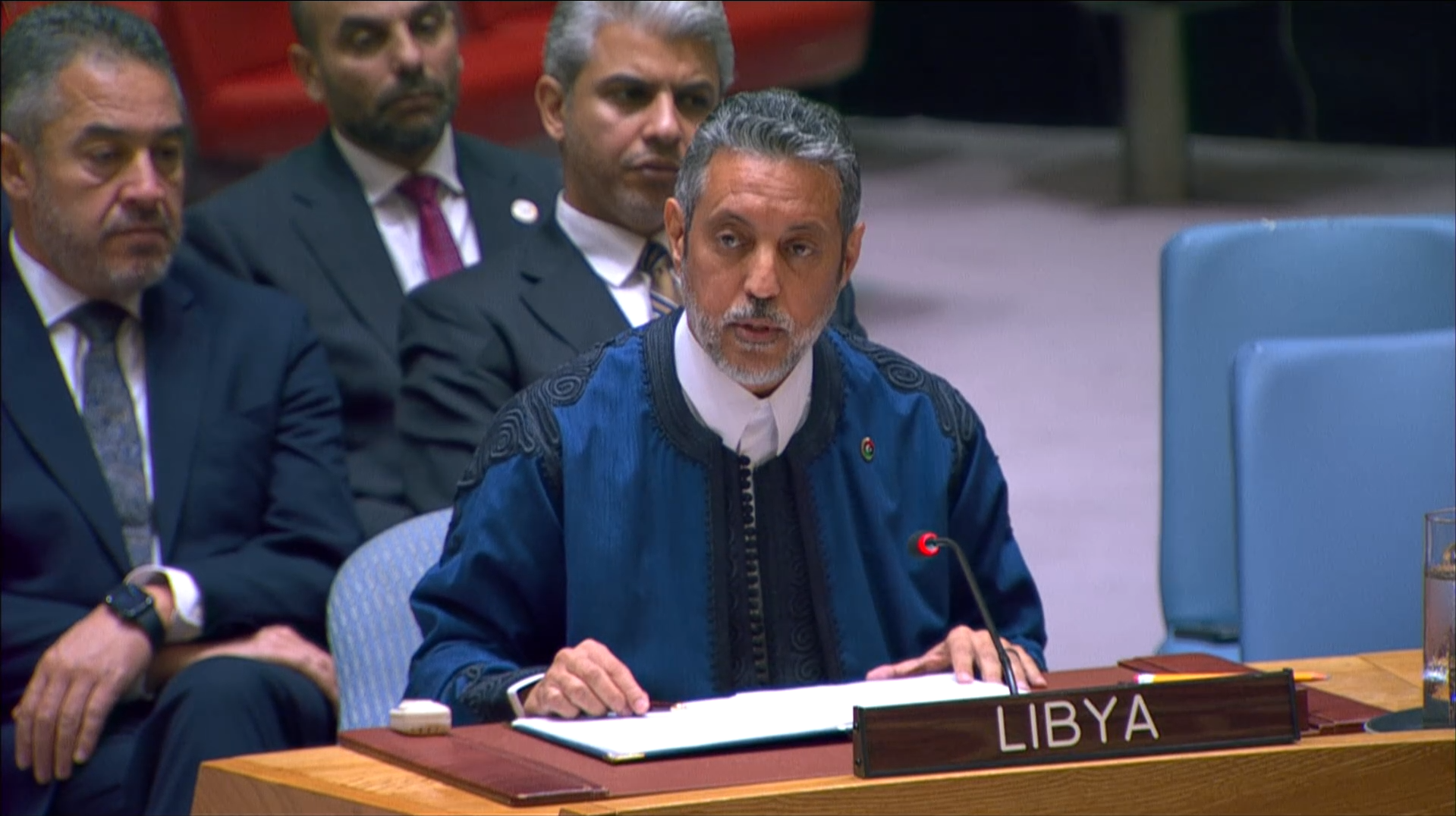

New York — October 14, 2026
United Nations Security Council Meeting on the Situation in Libya
Unofficial Translation
Libya Statement
Delivered by H.E. Mr. Taher M. T. El-Sonni, Ambassador Extraordinary & Plenipotentiary, Permanent Representative of the State of Libya to the United Nations
Madam President,
We wish you every success during your presidency of the Council this month, and we thank Ms. Hanna Tetteh for her briefing, the contents of which we have taken note of.
We reaffirm that the convening of these meetings must always be coupled with a genuine will to break the vicious cycle of political stalemate, move beyond conventional approaches, and advance towards tangible measures that fulfill the aspirations of the Libyan people for sovereignty and stability.
Ladies and Gentlemen,
When speaking of the political track and where matters stand today, it is essential to look back briefly in order to describe the course of events and place them in their proper context. The unified financial agreement, an experience launched nearly a year ago and built on direct negotiation, contributed, through the implementation of part of it, to tangible results reflected in the data issued by the Central Bank of Libya, the Ministry of Finance, and the National Oil Corporation.
That data revealed a significant gap between revenues and expenditure, estimated at around 24 billion dinars in favor of revenues. This, in turn, encouraged the United Nations Mission to adopt the same mechanism through the formation of the restricted dialogue committee (4+4), a track that led to swift political understandings on issues related to the electoral process, such as the draft presidential and parliamentary laws and the mechanism for selecting the Chair of the High National Elections Commission.
What has been achieved on this track can serve as a foundation on which to build in order to complete the resolution of outstanding files, including what has already begun within this track: examining the situation of the judicial institution and addressing the manifestations of division that have affected it, with a view to unifying it and strengthening its independence, as one of the fundamental requirements for creating the constitutional, legal, and institutional conditions necessary for holding presidential and legislative elections.
We stress here that reaching this legal and constitutional consensus is not an end in itself; rather, it is the only means of enabling the Libyan people to exercise their right to choose their leaders and determine the shape of their institutions. No political process can acquire legitimacy unless it stems directly from the voice of the people.
Ladies and Gentlemen,
Despite the foregoing, and the positive steps achieved in support of the electoral process through the 4+4 Committee, fundamental questions arise in people’s minds, raised by several institutions, political elites, and others. It is incumbent upon me today to convey them to you as they are, and with full transparency, as they await answers to them:
They ask: How does the UN Mission view the way it deals with and responds to the reservations and observations of several institutions and political forces regarding its working mechanism, its handling of the political track, and their non-participation in it? And what is the Mission’s policy for improving these mechanisms and broadening the circle of consultation and participation, in order to build on the restricted dialogue, ensure that no one is excluded, and guarantee the success of the political process and the national dialogue?
An example of these reservations and questions has been apparent to you in the rejection by the High Council of State in an official session, and in the reservations expressed by the Presidential Council in its correspondence to you regarding the methodology of the 4+4 Committee. They noted the importance of reviewing the degree of political and institutional acceptance before building on any outcomes, and that introducing certain amendments, if necessary, in consultation with these institutions and others, would be the most appropriate way to move forward on this track, so that it may be supported and endorsed through the necessary constitutional mechanisms.
They also warn that any parallel tracks lacking national consensus may lead to deepening the division of institutions rather than unifying them. It is important to ensure the integrity of selection mechanisms and institutional representation, so as to avoid producing new arrangements that may be subject to judicial challenge. The recent repercussions of a possible division of the House of Representatives, which had remained unified for many years, are evidence of the gravity of the current situation.
They further draw attention to the importance of preserving the Mission’s role as a neutral mediator and avoiding any steps that could be interpreted as bias towards a particular party. Neutrality means respecting political agreements and their institutions, so as not to entrench the principle of resorting to force, which threatens further erosion of state institutions, their stability, and the democratic path we seek. This also raises questions on their part regarding the implementability of any outcomes and the extent to which they contribute to addressing institutional division rather than deepening it.
These observations and warnings have gone so far as to prompt them to request the Secretary-General to conduct an independent assessment of the Mission’s performance and its governance and transparency mechanisms, while considering a shorter, conditional renewal of the Mission’s mandate with clear performance benchmarks.
This, Madam Special Representative, is what has been cautioned against, and we have now conveyed it to you: legitimate questions and concerns that require clarification. How will these disagreements be addressed to ensure the participation of all and the success of the tracks put forward?
Ladies and Gentlemen,
We reiterate the importance of respecting all national initiatives and dialogues that respond to the aspirations of Libyans, provided that they explicitly lead to a clear and binding electoral path, not to new transitional phases, culminating in free and fair elections under just, non-exclusionary, and implementable laws.
We also welcome any constructive international effort that supports dialogue and national consensus and seeks to end division, provided that it is subject to Libyan ownership and leadership, and complementary to the UN framework, the outcomes of the political agreements, and the relevant Security Council resolutions.
Ladies and Gentlemen,
The earlier attacks witnessed in areas of western Libya, which targeted vital oil and energy facilities using drones, remind us that the absence of a political solution and the multiplicity of power centers expose civilians and infrastructure to danger. We therefore categorically condemn the deliberate targeting of all civilian facilities, whatever the justification and whoever stands behind it.
As you have followed, the Government’s security services have uncovered the members of the cell that carried out this cowardly operation, and investigations are still ongoing to expose all those involved, so that the law may take its course and accountability for this crime is ensured, sooner or later.
We reaffirm that we will not allow the main source of Libyans’ income to be subjected to bargaining or to security or political pressure. Oil is not a bargaining chip, nor is it the property of any particular party, region, or group; it is a national wealth owned by all Libyans. We call for holding accountable, without selectivity, anyone proven to be involved in disrupting production, smuggling fuel and oil, or seizing revenues, and for pursuing, without discrimination, the local and international networks that benefit from these crimes.
In conclusion, we reaffirm that Libyan ownership of the political process should not remain a slogan repeated without being reflected in actual practice. Although Libyans hold firmly to their sovereign right to own their national decision and will not relinquish it, the scale of international engagement in Libyan affairs has become extensive and intertwined across various tracks.
Accordingly, and as we have stated before, what is required is for the international role to support the national will, not replace it; to back Libyan institutions, not bypass them; and for Libyan ownership to be transformed from a declared principle into an actual practice that respects the right of Libyans to determine the future of their state.
Despite all the challenges mentioned, I assure you that Libya has returned, and continues to return, to its regional and international sphere, and we look forward to partnership with all in every field, founded on parity and respect for national sovereignty.
Thank you, Madam President.