


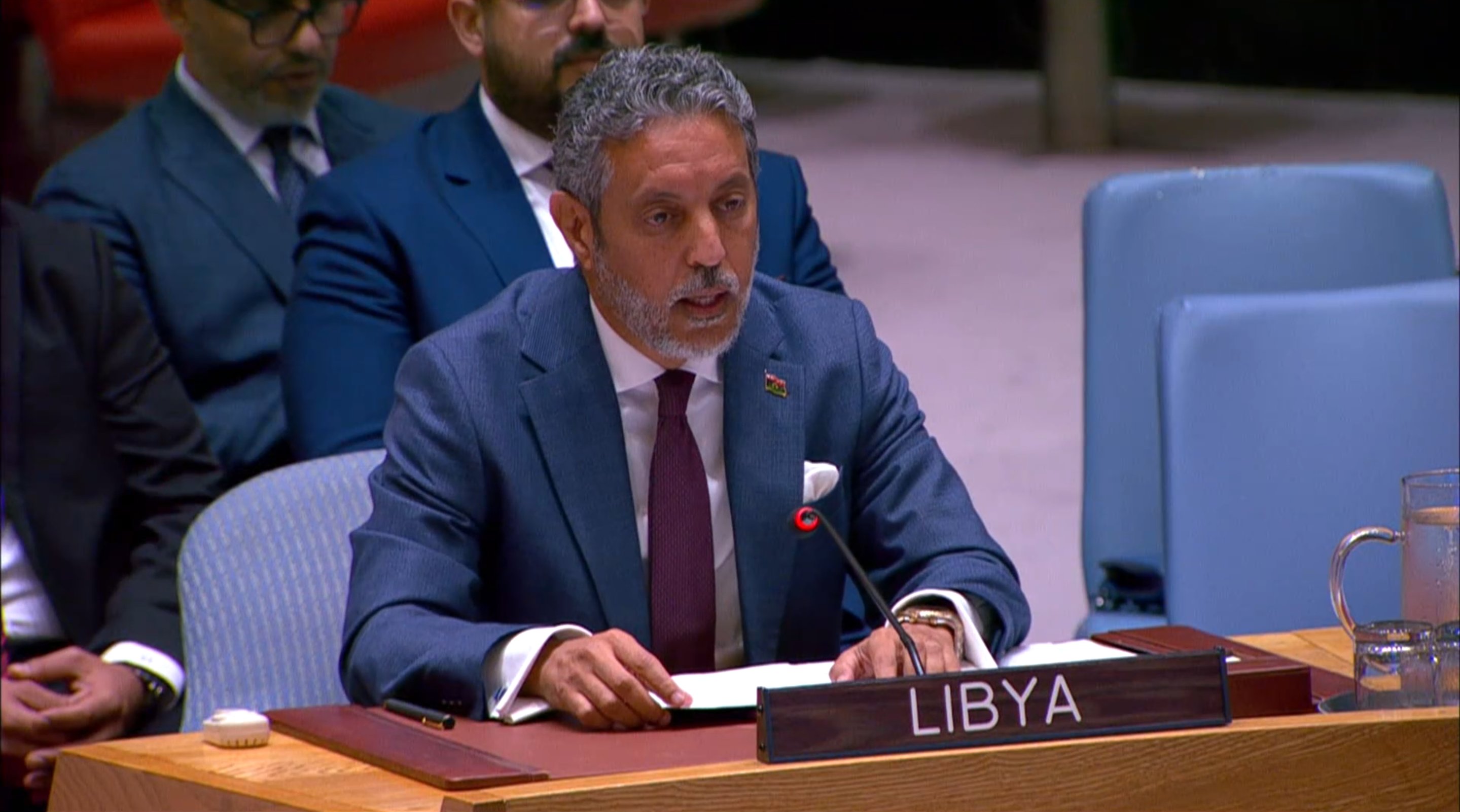

New York — August 18, 2026
United Nations Security Council Briefing on the Situation in Libya
Unofficial Translation
Libya Statement
Delivered by H.E. Mr. Taher M. T. El-Sonni, Ambassador, Permanent Representative of the State of Libya to the United Nations
Madam President,
At the outset, and before delivering our statement, we must reaffirm that the convening of these meetings must be coupled with a genuine will to break the vicious cycle of political stalemate, move beyond stereotypical approaches, and advance towards tangible measures that fulfill the aspirations of the Libyan people for stability, lift Libya out from under the grip of Chapter VII, and bring an end to all chapters of the crisis in my country. The responsibility is a shared one.
Ladies and Gentlemen,
We commend the tangible progress announced by the UN Special Envoy in her briefing today, and the understandings reached between the two main parties in the (4+4) Committee, which were swiftly achieved during the consultations held over the past two months, concerning consensus on the draft presidential and parliamentary electoral laws and the mechanism for selecting the Chair of the High National Elections Commission.
We stress that these laws are not an end in themselves; rather, they are the sole instrument to enable the Libyan people to exercise their right to choose their leaders and determine the shape of their institutions. No political process can acquire legitimacy unless it stems directly from the voice of the citizen.
We reaffirm the importance of respecting all national initiatives and dialogues that respond to the aspirations of Libyans, provided that they lead, explicitly and unequivocally, to an immediate and lasting end to all transitional phases, through free and fair elections, based on just, non-exclusionary, and implementable laws.
We also welcome any constructive international effort that supports national dialogue and seeks to end division, provided that it is Libyan-owned and Libyan-led, and complementary to the UN framework, the outcomes of the political agreements, and the relevant Security Council resolutions.
We affirm that Libyan ownership of the political process must not remain a slogan that is repeated without being reflected in actual practice. While Libyans hold firmly to their sovereign right to own their national decision and will not relinquish it, the scale of international engagement in Libyan affairs has become extensive and influential across various tracks. Therefore, the international role must support the national will rather than replace it, and back Libyan institutions rather than bypass them. Libyan ownership must be transformed from a declared principle into an actual practice that respects the right of Libyans to determine the future of their state.
Ladies and Gentlemen,
In these exceptional circumstances Libya is going through, we appreciate all international efforts exerted to support the economic track and the agreement on unifying the budget and development spending. However, the time has come to know why it has not been implemented yet! Nine months after the signing of the agreement between the House of Representatives and the High Council of State, and four months after the approval of the spending tables last April, we once again sound the alarm over the continued challenges of non-implementation.
Controlling and unifying public spending is no longer a file that can be postponed; it is rather a top national priority to protect the Libyan dinar, safeguard monetary stability, and preserve the people’s resources from reckless depletion.
In this framework, and to ensure the success of these agreements, we also call on all to support the independence of the Central Bank of Libya in exercising its legal and professional mandates, away from political pressures and polarization.
Hence, the time has come for this agreement to enter into force and to be made public, and available to state institutions for review, particularly oversight bodies, in order to ensure transparency, accountability, and the commitment of all to its provisions.
The deterioration of basic services for citizens today and the persistence of livelihood crises, foremost among them the energy and electricity crisis, are no longer linked solely to technical matters and a lack of resources; they are also linked to corruption networks and the crimes of smuggling fuel and crude oil. These are organized economic crimes that are no less serious and destructive in their impact than armed crimes.
In this context, while we welcome the listing by the Sanctions Committee, on 22 July, of a tanker for its involvement in oil smuggling, we ask: how can the international community settle for listing only one tanker, while entire fleets are moving to plunder the wealth of Libyans in full view of the world? We call on this Council and the Sanctions Committee to act decisively and pursue all individuals, networks, and entities involved, and those standing behind them locally and internationally, without selectivity. They are undoubtedly well known to you.
These and other steps will enhance transparency and accountability with regard to the collection of oil revenues and marketing contracts by the competent authorities, as stated in the reports of the Panel of Experts and others.
In the same vein, we welcome the adoption by the Sanctions Committee, on 6 July, of the guidance note that allows the Libyan Investment Authority to reinvest frozen cash balances, while they and their returns remain frozen. This is what we have repeatedly called for, in order to protect the funds of the Libyan people and the wealth of their future generations from depletion. It is unacceptable that Libyans’ funds remain locked in foreign banks that benefit from them and deduct exorbitant fees, while their real value erodes due to inflation and negative interest rates. This is called systematic plunder, and we will not allow it.
Speaking of sanctions, we remind the Council of our repeated request to delist certain citizens whose reasons for inclusion on the sanctions list no longer exist, after nearly 15 years, whether they are representatives of the former regime or others.
Ladies and Gentlemen,
We call on the international community to support all tracks of military dialogue and joint security meetings that bring together military leaders from across the country. We see the continuation of this communication as a genuine safety valve to prevent sliding back into armed confrontations, for which the Libyan people have paid a heavy price.
The Government of National Unity continues to implement a gradual strategy to regulate the security and military landscape. This strategy, which began in 2021, is based on dealing realistically with existing military and security formations, by organizing them, guiding their conduct, subjecting their performance to the requirements of the State and its institutions, and making use of the elements and formations that can be reorganized and rehabilitated to carry out security tasks and protect citizens and facilities.
The Government has acted in line with multiple assessments and tracks: measures aimed at ending and dissolving certain formations or tasks that are no longer consistent with the requirements of the State, and other tracks based on containing formations capable of discipline, redirecting them, and integrating their capabilities within the framework of state institutions.
Accordingly, we categorically condemn and reject the logic of political assassination and resorting to violence wherever it occurs, as well as the deliberate targeting of vital civilian, oil, and other facilities. These are dangerous practices that raise legitimate questions about the agendas seeking to undermine de-escalation and drag the country into a new spiral of escalation.
The Libyan street, which has suffered for years from the scourge of conflict and fighting, looks forward to seeing courageous practical steps that lead to the unification of the military institution under civilian leadership, restricting the bearing of arms and the decision to use them to the State, and ending all forms of foreign presence. Sustainable security will only be achieved by ending all armed manifestations outside the law, because the security and military tracks are the cornerstone for building and protecting the political settlement.
In conclusion,
We affirm that the strategic importance of Libya must not be reduced to its energy resources and reserves, but extends to its location and role in the equation of Mediterranean security, energy security, and international trade. The stability of Libya and the securing of its coasts and institutions constitute an important element in the stability and security of the Mediterranean and the region, and in protecting one of the most important spaces and corridors for energy and trade between Africa and Europe.
As we have stated on several occasions, all that is mentioned regarding division and challenges in all files, particularly those affecting Libyan citizens, whether economic, security, humanitarian, or otherwise, are merely symptoms of not yet having reached a radical and comprehensive political solution; a political solution built on pluralism and genuine democracy, and based on a constitution and a civil state: a state of institutions and law, a state that holds the monopoly on arms and has a unified army whose doctrine is to protect the country and defend the homeland.
The conflict that has been ongoing for years was, and remains, the result of multiple foreign interventions. The crisis has been exploited to advance agendas and wage proxy conflicts, and there is ample evidence of this in neighboring countries and the region. We therefore call on you once again today for a positive international partnership, a partnership of equals that respects the will and sovereignty of the Libyan people. We thank the countries that have adopted this approach, and we expect the rest to follow suit and adjust their policies so that all may benefit. History is recording… history will not be merciful, and Libyans will remember.