


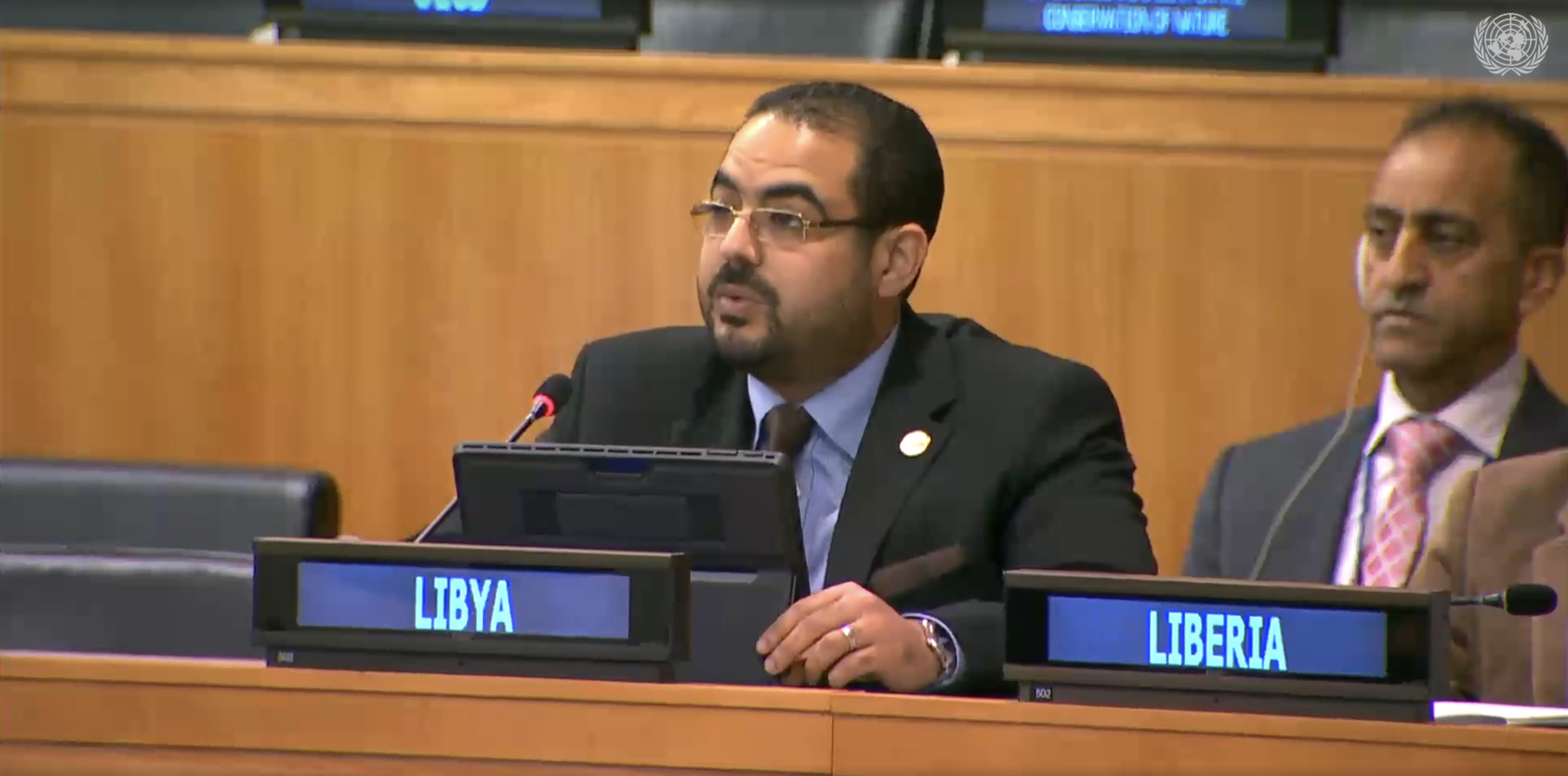
Arab Group Statement in the Joint General Discussion on Poverty and Food Security – 81st Session of the Second Committee

New York — October 14, 2026
Joint general discussion of the Economic and Financial Committee (Second Committee) at its 81st Session on Agenda Item 21: Eradication of Poverty and Other Development Issues, and Agenda Item 23: Agricultural Development, Food Security and Nutrition
Unofficial Translation
Libya Statement on behalf of the Arab Group
Delivered by Mr. Ahmed I A Aldredi, First Secretary, Permanent Mission of the State of Libya to the United Nations
Madam Chair,
I have the honor to deliver this statement on behalf of the Arab Group, and to extend our thanks to you and the members of the Bureau for your efforts, and to the Secretary-General for the reports submitted.
Madam Chair,
The eradication of poverty in all its forms and dimensions remains a priority for the Arab Group. The report of the Secretary-General warns that the conflict in the Middle East could push an additional 4 million people into poverty in the Arab region. The Group stresses the need to address its multiple causes, restore services, productive capacities, and livelihoods, and protect development gains from the repercussions of conflicts, displacement, and climate change.
In this context, the Group underscores the importance of expanding shock-responsive social protection and paying special attention to rural and marginalized communities. It calls for fulfilling official development assistance commitments, scaling up concessional finance and grants, addressing debt burdens, implementing the Sevilla Commitment, and respecting national ownership and development priorities. It also calls for the lifting of unilateral coercive measures that contravene international law, which constitute a major obstacle to development and exacerbate the suffering of peoples.
Madam Chair,
The eradication of poverty is closely linked to achieving food security and improving nutrition. According to the 2025 Regional Overview of Food Security and Nutrition, nearly 78 million people in the Arab region suffered from hunger, and nearly 198 million people faced moderate or severe food insecurity.
The Group calls for improving water-use efficiency, combating desertification and land degradation, and investing in climate-resilient agriculture, as well as increasing adaptation finance and strengthening early warning mechanisms.
The success of these efforts also requires ensuring the integrity of supply chains and the security of maritime corridors. Accordingly, the Group renews its condemnation of Iran’s closure of the Strait of Hormuz and its disruption of international navigation therein, and affirms that the disruption of oil and gas supplies, particularly natural gas used in fertilizer production, together with rising production and transport costs and food prices, exacerbates the risks of poverty and hunger. The Group condemns Iran’s targeting of civilian facilities, including desalination plants, and stresses the critical importance of protecting water facilities, food production and distribution, and objects indispensable to the survival of the civilian population. It calls for the full implementation of Security Council resolution 2817, and for Iran to immediately refrain from actions and threats that impede lawful transit passage or freedom of navigation in the Strait of Hormuz, or that threaten maritime security in the Bab al-Mandab, in accordance with international law and the United Nations Convention on the Law of the Sea.
Madam Chair,
The Group renews its condemnation of the aggression of the Israeli occupying authority against the defenseless Palestinian people in the Occupied Palestinian Territory, and its destruction of infrastructure and the food and agricultural system, particularly in the Gaza Strip. It condemns the occupying authority’s use of starvation of civilians as a method of warfare, as referred to in Security Council resolution 2417, and demands the protection of civilians, the lifting of the blockade, unimpeded access for humanitarian assistance, and support for recovery and reconstruction led by Palestinian institutions.
The Group condemns the Israeli occupation forces’ use of white phosphorus in populated areas in Lebanon, in violation of international law, as well as their use of the herbicide glyphosate in high concentrations in southern Lebanon, and the resulting serious and chronic consequences for human health and the environment, and the threat it poses to agricultural production, food security, and the livelihoods of farmers.
The Group also condemns the continued depletion by the Israeli occupation of natural resources in the occupied Syrian Golan, the confiscation of agricultural land, and the construction of wind turbines at the expense of the livelihoods of Syrian farmers, which constitutes a flagrant violation of international humanitarian law.
The Group calls for strengthening support to Yemen, Sudan, and Somalia, supporting recovery and reconstruction, and providing adequate and predictable humanitarian and development financing that links relief with the restoration of livelihoods and food systems.
In conclusion, the Arab Group reaffirms its commitment to eradicating poverty and hunger, and calls for translating pledges into funded programmes and tangible results to implement the 2030 Agenda and achieve its Goals, leaving no country or individual behind.
Thank you, Madam Chair.