


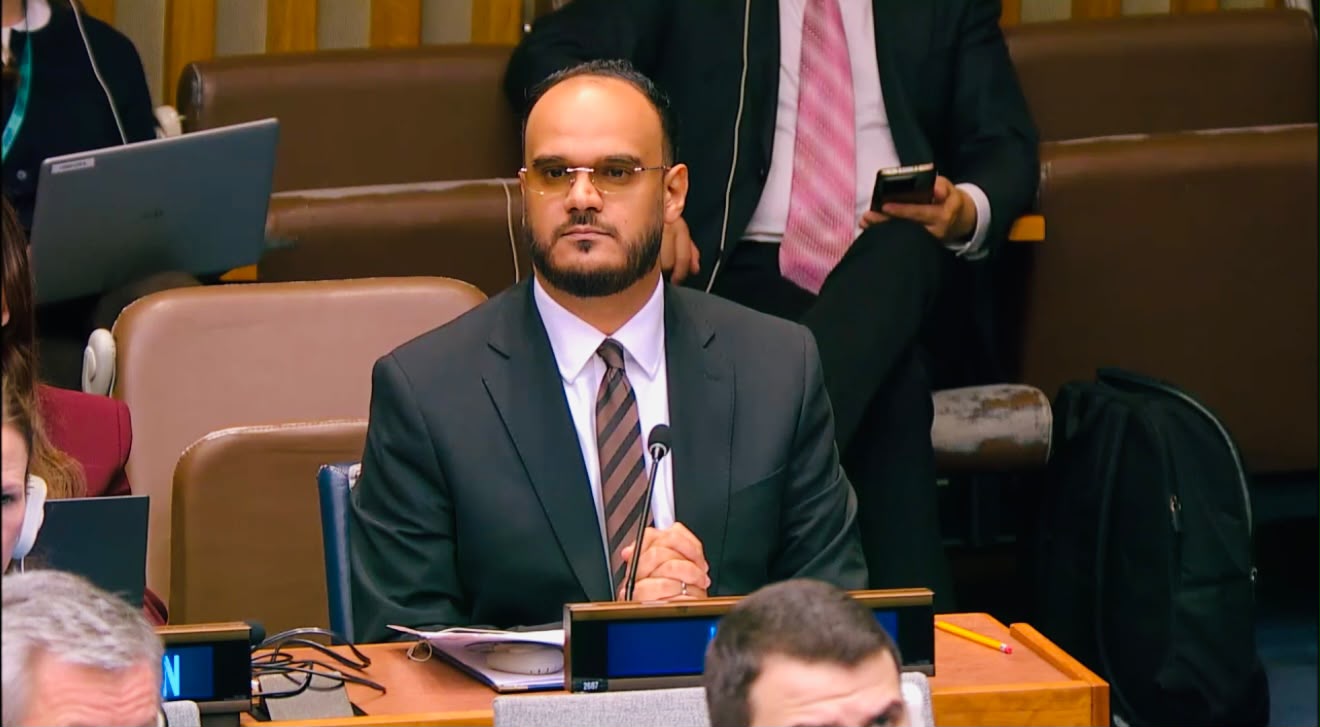
Arab Group Statement in the General Discussion of the First Committee – 81st Session

New York — October 7, 2026
General Discussion of the Disarmament and International Security Committee (First Committee) at its 81st Session
Unofficial Translation
Libya Statement on behalf of the Arab Group
Delivered by Mr. Abdullah M O Aletwi, Second Secretary, Permanent Mission of the State of Libya to the United Nations
Mr. Chair,
I am pleased to extend to you, H.E. Ambassador Lok Bahadur Thapa, the distinguished Permanent Representative of Nepal, my sincere congratulations on your election as Chair of the First Committee at the eighty-first session of the General Assembly. We also congratulate the members of your Bureau, in which we are pleased to see Arab representation through the brotherly Republic of the Sudan. The Arab Group also aligns itself with the statement of the Non-Aligned Movement.
We cannot open this statement without expressing our deep regret over the restrictions faced by the delegation of the State of Palestine in participating in the work of the Assembly, which prevented the President of the State of Palestine from being physically present during the high-level segment. At a time when the Palestinian voice is being targeted within the United Nations, the violations of the Israeli occupation continue, having deliberately caused a famine documented by the United Nations, forcibly displaced millions, and violated every principle and purpose of the Charter of the United Nations and international law.
At the same time, the Arab Group condemns the unlawful military attack launched by the Israeli occupying authority against Iranian nuclear facilities placed under the Agency’s comprehensive safeguards regime. It also condemns the Iranian targeting of a number of infrastructure facilities in the Arab Gulf States, including nuclear facilities devoted exclusively to peaceful purposes, which is inconsistent with the rules of international law and constitutes a flagrant violation of the principles of the Charter of the United Nations.
Mr. Chair,
The Arab Group stresses the imperative of eliminating nuclear weapons and harnessing the enormous resources allocated to them for development. As we have previously affirmed, the only effective means of preventing the use or threat of use of nuclear weapons is their total and irreversible elimination, including through the implementation of agreed commitments in accordance with the Charter of the United Nations, under the Treaty on the Non-Proliferation of Nuclear Weapons, and other internationally agreed commitments, which remain the most appropriate and effective approach to achieving the goal of the total elimination of nuclear weapons.
The Arab Group wishes to once again express its grave concern over the continued failure, for the third time, to adopt a final document at the Review Conference of the Parties to the Treaty on the Non-Proliferation of Nuclear Weapons, most recently in April 2026, as well as the failure to achieve the universality of the Treaty. The nuclear-weapon States refrain from implementing their obligations under Article VI of the Treaty and evade setting any specific timeframes, while continuing the quantitative and qualitative development of their nuclear arsenals amid a continued erosion of arms control arrangements and the continued implementation of nuclear sharing and extended nuclear deterrence policies that contravene the spirit and letter of the Non-Proliferation Treaty. In this regard, the Group calls for the commencement of negotiations leading to a comprehensive convention on nuclear disarmament.
The Arab Group also stresses the need to continue the balanced implementation of the three pillars of the Non-Proliferation Treaty, in particular the disarmament pillar, which has seen the least progress in implementation. It further stresses the need to activate the pillar of cooperation in the peaceful uses of atomic energy and to support non-nuclear-weapon States in exercising their inalienable right to the peaceful use of atomic energy, while continuing to comply with their obligations under comprehensive safeguards agreements with the Agency, particularly at a time when some States benefit from expanded and privileged nuclear cooperation despite not being parties to the Treaty on the Non-Proliferation of Nuclear Weapons.
In this context, the Arab Group takes pride in the State of Kuwait assuming, by acclamation, the chairmanship of the Board of Governors of the International Atomic Energy Agency for the period 2026–2027, as an embodiment of the international confidence it enjoys and in recognition of its role in promoting cooperation and dialogue and supporting the peaceful uses of atomic energy. The Group wishes the State of Kuwait every success in carrying out this responsibility, in a manner that strengthens the Agency’s role in serving peace and development and safeguards the inalienable right of States to the peaceful use of nuclear energy.
The Group notes that, while recognizing the positive contributions of confidence-building and nuclear risk reduction efforts, these are not substitutes for the implementation of effective nuclear disarmament measures. It warns of the risks of integrating artificial intelligence into the handling of nuclear weapons, and stresses the need to ensure full human control over such weapons.
Mr. Chair,
The Group took note, with profound shock, of statements made in 2023 by a minister of the Israeli occupation threatening to drop a nuclear bomb on the Gaza Strip and its besieged Palestinian people. These are extremist and irresponsible statements and positions that must be condemned categorically, firmly, and unequivocally by the Security Council and the General Assembly, and they underscore the utmost necessity of establishing a nuclear-weapon-free zone in the Middle East as an indispensable pillar for regional and international peace and security.
The Group reaffirms the prominent role of treaties establishing nuclear-weapon-free zones. It reiterates that the continued refusal of the Israeli occupation to accede to the Treaty on the Non-Proliferation of Nuclear Weapons and to place its nuclear facilities under the comprehensive safeguards regime of the International Atomic Energy Agency constitutes a serious threat to peace and security, in addition to violating dozens of United Nations resolutions, including Security Council resolutions 487 and 687.
The Group reiterates its grave concern over the continued procrastination by some concerned parties in implementing the resolution of the 1995 Review and Extension Conference of the Parties to the Treaty on the Non-Proliferation of Nuclear Weapons on the establishment of a zone free of nuclear weapons and other weapons of mass destruction in the Middle East, as well as the provisions of the final document of the 2010 Review Conference. The Group recalls that the resolution on establishing a nuclear-weapon-free zone in the Middle East was, and remains, an integral part of the deal on the indefinite extension of the Treaty.
In this framework, the Arab States stress the need to take immediate executive steps towards the establishment of that zone. The Arab Group once again submits to this session the Arab draft resolution entitled “The risk of nuclear proliferation in the Middle East,” looking forward to continued broad support for it. The Group also affirms its support for the resolution entitled “Establishment of a nuclear-weapon-free zone in the region of the Middle East,” and calls for the adoption of both by consensus.
In this context, the Arab Group welcomes the convening of six sessions of the Conference on the Establishment of a Middle East Zone Free of Nuclear Weapons and Other Weapons of Mass Destruction, and looks forward to continuing the important and constructive discussions held at this Conference during its seventh session, to be presided over by the delegation of the Sultanate of Oman in November 2026. The Group urges all parties invited to this Conference, as members or observers, to participate in this forum, which has established itself as a constructive platform for negotiating a legally binding treaty in this regard.
Mr. Chair,
The Arab Group affirms its support for international efforts to promote the universality of multilateral conventions and treaties on the disarmament of nuclear weapons and other weapons of mass destruction, and calls on all States to consider acceding to the Comprehensive Nuclear-Test-Ban Treaty, including the Annex 2 States, while emphasizing the special responsibility of the nuclear-weapon States in accordance with Action 10 of the 2010 Review Conference Action Plan, as well as of the parties that have not yet acceded to the Treaty on the Non-Proliferation of Nuclear Weapons.
The Group also affirms the importance of the Treaty on the Prohibition of Nuclear Weapons in placing nuclear weapons in their logical position as weapons that contradict the most basic rules of international humanitarian law. In this framework, the Arab Group calls on all nuclear-weapon States to commit to the principle of no first use of nuclear weapons, and to provide legally binding, effective, and unconditional assurances not to use nuclear weapons against any non-nuclear-weapon State, pending the completion of the elimination of nuclear weapons.
Mr. Chair,
The Arab Group believes in the importance of keeping outer space free from arms races and conflicts, and of focusing its use on peaceful purposes. While the relevant international agreements have played a positive role, there remains a significant gap that requires expediting the conclusion of a new legally binding international instrument that would prohibit the placement of weapons in outer space. In this context, the Arab Group welcomes the positive progress achieved during the meetings of the new merged working group established pursuant to resolution 79/512, which unified the tracks addressing this file under the umbrella of the United Nations, and looks forward to the continuation of the group’s work.
In the field of cybersecurity, the Group stresses the importance of supporting international cooperation to strengthen the security of information and communications technologies, in a manner that fortifies States and enhances their capabilities against any destructive attacks. The Group is keen on maintaining the central role of the United Nations in developing the framework of international norms for information and communications security, consistent with international law. The Group welcomes the launch of the work of the Future Mechanism on cybersecurity and the appointment of the co-facilitators of the two working groups under its umbrella, in which the Arab Group is represented by a representative of the brotherly Arab Republic of Egypt. The Group welcomes the convening of the first substantive session of the Mechanism in July 2026, and welcomes the procedural decision to be introduced by El Salvador, as Chair of the Mechanism, during the current session, and urges all States to support this track as the sole umbrella for addressing this file at the United Nations.
Furthermore, the Arab Group notes the growing role of emerging technologies, foremost among them artificial intelligence applications, in the military domain, and hence the need to launch an inclusive discussion based on compliance with international law and strengthening human control. Accordingly, the Group follows the efforts of the Netherlands and the Republic of Korea in advancing discussions on this file in the form of informal consultations under the umbrella of the United Nations, and expresses its hope to deepen the scope of engagement and consolidate the format of the meetings, leading to a formal discussion on this important file.
Mr. Chair,
The Group affirms the right of States to manage their stockpiles of conventional weapons and ammunition in a manner that meets their defense and security needs, consistent with Article 51 of the Charter of the United Nations. It also stresses the utmost importance of the full and effective implementation of the United Nations Programme of Action to Prevent, Combat and Eradicate the Illicit Trade in Small Arms and Light Weapons, particularly with regard to combating the increasing flows of such weapons to terrorists and armed groups. The Group welcomes the convening of the Ninth Biennial Meeting of States on the Programme of Action in New York in June 2026 and the adoption of its final report, while also recalling the importance of the Global Framework for Through-life Conventional Ammunition Management and looking forward to the next meeting of States on the Framework in 2027. The Group takes pride in the election of the State of Kuwait, one of its member States, as a Vice-Chair of the preparatory meeting, and in the recommendation of its nomination as a Vice-Chair of the 2027 Meeting of States, reflecting the contribution of Arab States in supporting and strengthening the implementation of this track. The Group stresses the need to ensure that the implementation of the Global Framework does not overlap with the Programme of Action on Small Arms and Light Weapons.
In conclusion, the Arab Group expresses its regret that the most recent session of the Conference on Disarmament was unable to hold a substantive discussion within the framework of the two working groups under its umbrella, due to the lack of political will on the part of some States. The Arab Group stresses the need to continue working to revitalize the role of the Conference on Disarmament and its negotiating mandate.
Thank you very much.