


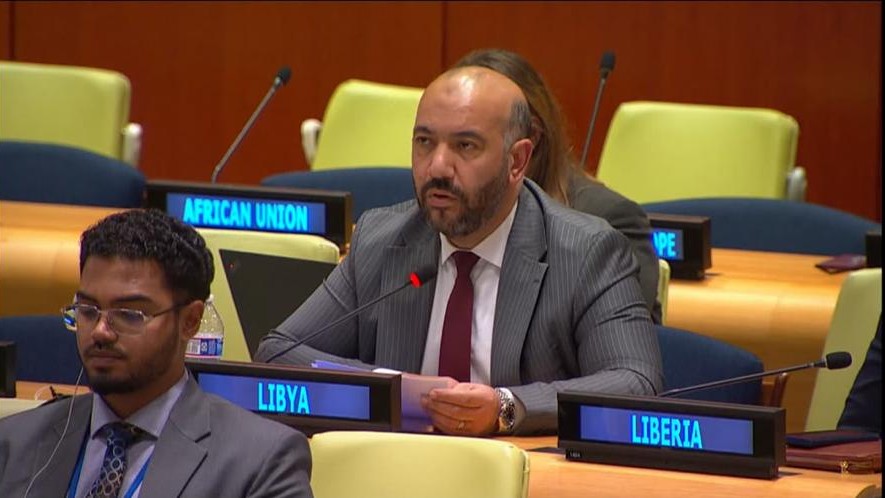
Arab Group Statement in the General Discussion on the Rule of Law – 81st Session of the Sixth Committee

New York — October 8, 2026
General Discussion of the Legal Committee (Sixth Committee) at its 81st Session on the Agenda Item: The Rule of Law at the National and International Levels
Unofficial Translation
Libya Statement on behalf of the Arab Group
Delivered by Mr. Hatem Y A Eltelb, Counsellor, Permanent Mission of the State of Libya to the United Nations
The Arab Group affirms that the rule of law is the cornerstone for ensuring freedom, justice, dignity, and equality, and a fundamental pillar for promoting international peace and security in accordance with Article 1 of the Charter of the United Nations, which provides for the settlement of international disputes by peaceful means and in conformity with the principles of justice and international law. The rule of law also contributes to achieving sustainable development and protecting economic, social, and political rights, consistent with Article 55 (c) of the Charter, which obliges the United Nations to promote respect for human rights and fundamental freedoms.
In this framework, consolidating the principle of the rule of law at the national and international levels requires respect for the obligations arising from Article 2, paragraph 2, of the Charter, which requires States to fulfil their international obligations in good faith, and ensuring that the sovereign equality of States is not undermined. The Group also affirms the importance of the pivotal role of the United Nations in supporting national capacities to strengthen justice and accountability, in accordance with the annual General Assembly resolutions on the rule of law.
Based on the foregoing, the Arab Group wishes to emphasize the following points:
- The Arab Group renews its call for an immediate halt to the war of genocide against the Gaza Strip and an end to the illegal occupation of the State of Palestine. The Group strongly condemns the continued violations by the Israeli occupation authorities of the rule of international law and of the decisions of the International Court of Justice, and their practices of systematic destruction, deliberate starvation, forced displacement, and sexual violence and rape as a weapon of war, as well as settlement, annexation, apartheid, and terrorism, including settler terrorism supported and coordinated by the Israeli occupation authorities.
- The Arab Group renews its call for an end to the Israeli aggression against Lebanon and the withdrawal of the occupation forces from the areas they occupy therein, and renews its support for the Lebanese State in extending its sovereignty and control over the entirety of Lebanese territory, including the State’s exclusive authority over decisions of war and peace, restricting arms to the State, and disarming all non-State actors, as well as proceeding with its reform and institution-building programmes.
- The Arab Group condemns in the strongest terms the continued Israeli violations and attacks against the Syrian Arab Republic, foremost among them the incursions into its territory since 8 December 2024, the arrests and abductions targeting civilians, including children, as well as air strikes, the unlawful entry of occupation forces into its territory, settlement expansion, and attacks launched against Lebanon from Syrian territory. The Group affirms that these practices constitute a violation of Syria’s sovereignty and territorial integrity, and demands their immediate cessation, the full and immediate withdrawal of the occupation forces from all territories into which they have advanced since that date, and full compliance with the 1974 Disengagement of Forces Agreement. The Group also demands the full implementation of the relevant Security Council resolutions, in particular resolution 497 (1981), and full withdrawal from the occupied Syrian Golan.
- Affirming that the right of the Palestinian people to self-determination is a peremptory norm of international law, that recognition of the State of Palestine is a right of the Palestinian people and a duty of the international community, and warning that threats to withdraw recognition of the State of Palestine constitute a breach of international obligations towards achieving a just, lasting, and comprehensive peace in the Middle East.
- Condemning the repeated attacks on Islamic and Christian holy sites, and the attempts by the illegal Israeli occupation to change the historical and legal status quo in Al-Quds Al-Sharif, and other violations and crimes, including the Israeli escalation at Al-Aqsa Mosque/Al-Haram Al-Sharif, in particular the repeated incursions by settlers, including ministers of the occupation authorities, under the protection of the occupation forces, and the accompanying provocative practices, including the raising of the occupation’s flag within the Mosque’s compound.
- Condemning the discriminatory restrictions imposed by the occupation authorities on access to the Old City and places of worship, and the systematic measures aimed at changing the historical, legal, and demographic character of occupied East Jerusalem and violating the sanctity of its Islamic and Christian holy sites. We affirm that the Israeli occupation authorities have no sovereignty over occupied Jerusalem or over its Islamic and Christian holy sites.
- Stressing the need to respect the historical and legal status quo at the holy sites. We affirm that Al-Aqsa Mosque/Al-Haram Al-Sharif, in its entire area of 144 dunums, is an exclusive place of worship for Muslims, and that the Jerusalem Awqaf and Al-Aqsa Mosque Affairs Department, affiliated with the Jordanian Ministry of Awqaf, Islamic Affairs and Holy Places, is the sole competent authority for its administration, based on the historic Hashemite Custodianship of the Islamic and Christian holy sites in Al-Quds Al-Sharif.
- Commending the efforts of His Majesty King Mohammed VI, King of Morocco, in his capacity as Chairman of the Al-Quds Committee, in defending Al-Quds Al-Sharif, particularly through the initiatives and projects implemented by the Bayt Mal Al-Quds Agency, the Committee’s executive arm, aimed at preserving the legal and historical status of Jerusalem, protecting its identity, and supporting the resilience of its people.
- Condemning the decision of the Israeli occupation authorities on the declared annexation through the implementation of the E1 plan, and the issuance of tenders for the construction of 1,234 settlement units as part of an expansionist plan to build 3,401 units in the strategic E1 area, as this step fragments the West Bank and permanently isolates the city of Jerusalem from its natural, geographic, and demographic Palestinian extension. This constitutes a serious aggressive escalation that defies the international will, entrenches the illegal Israeli occupation and apartheid regime, and threatens to undermine the security and stability of the Middle East. The Group commends the positions of the States that have condemned and rejected these plans.
- Affirming that the Palestinian territory constitutes a single geographic, political, and territorial unit, comprising the West Bank, including Al-Quds Al-Sharif, and the Gaza Strip; calling for respect for the unity and integrity of the territory of the State of Palestine; rejecting all attempts to separate any part of the Occupied Palestinian Territory; and categorically rejecting the imposition of any new political, security, or administrative realities upon it. The Group stresses the need to enable the Government of the State of Palestine to assume its full responsibilities and powers over the entire Occupied Palestinian Territory, and affirms that sovereignty is Palestinian, and that the occupation has no sovereignty over any part of the Occupied Palestinian Territory, including Al-Quds Al-Sharif.
- Stressing the pivotal importance of the United Nations Relief and Works Agency for Palestine Refugees in the Near East (UNRWA) as an irreplaceable United Nations mechanism, and rejecting all attempts to undermine its legal mandate. The Group warns of the dangers arising from the targeting of Palestine refugee camps in the Occupied Palestinian Territory, including destruction and forced displacement, as a violation of international law and an attempt to liquidate the question of Palestine refugees. It stresses the need to implement resolution 2730 (2024), which mandates the protection of humanitarian personnel, and condemns attacks on UNRWA as a clear violation of Article 100 of the Charter of the United Nations, which guarantees the independence and impartiality of the Organization’s staff. It also warns against the recent measures by the Israeli occupation authorities designating UNRWA as a “terrorist organization,” and the resulting targeting of the Agency’s premises by the occupation authorities, including ministers in these authorities, in contravention of the principle of the functional immunity of the United Nations enshrined in the 1946 Convention on the Privileges and Immunities of the United Nations.
- Highlighting the gravity of the continued aggression by the Israeli occupation forces against the Palestinian people, its repercussions on regional and international security and stability, and its flagrant contravention of international law, including international humanitarian law and human rights law, the relevant resolutions of international legitimacy, and the advisory opinions and provisional measures issued by the International Court of Justice, as a threat to all efforts aimed at a peaceful settlement in the Middle East based on international law, the rights of the Palestinian people, and the implementation of the two-State solution.
- The continued breach by the illegal Israeli occupation authorities of the decisions of the International Court of Justice, the Security Council, and the General Assembly, including resolutions 242 (1967), 338 (1973), and 2334 (2016), and of the 2004 Advisory Opinion of the International Court of Justice on the Legal Consequences of the Construction of a Wall in the Occupied Palestinian Territory, constitutes a violation of the principle of the inadmissibility of the acquisition of territory by force enshrined in Article 2, paragraph 4, of the Charter, and a breach of the principle of respect for the rule of international law.
Mr. Chair,
The Arab Group stresses the need to hold the occupying Power accountable for all its crimes against the Palestinian people, including before the International Court of Justice and all other relevant legal mechanisms. The Group affirms that accountability is an integral part of the concept of the rule of international law. It also affirms that the case pending before the International Court of Justice brought by South Africa against the occupying Power, under the 1948 Convention on the Prevention and Punishment of the Crime of Genocide, constitutes a genuine test of the ability of the international legal order to enforce justice and prevent impunity.
In the same context, the Group warns that any attempts to displace Palestinians from their land will be confronted decisively and firmly, as this is a condemned, rejected, and punishable crime under the Fourth Geneva Convention. It also warns that any move by the occupying Power and its officials to impose such displacement will push the entire region into a wider cycle of violence and a regional war, and we stress that its effects will not be confined to our region alone, but will extend far beyond it. The Arab Group urges the International Criminal Court to expedite the completion of the criminal investigation into war crimes and crimes against humanity, and to issue new arrest warrants against officials of the occupation authorities for the crimes they have committed against the defenseless Palestinian people, including the crimes of settlement and annexation, genocide, aggression against Gaza, the killing of civilians, doctors, journalists, paramedics, and civil defense crews, and the forced displacement of Palestinians.
Mr. Chair,
The Arab Group condemns and denounces in the strongest terms the heinous and repeated Iranian attacks that targeted the territories of the Hashemite Kingdom of Jordan, the United Arab Emirates, the Kingdom of Bahrain, the Kingdom of Saudi Arabia, the Sultanate of Oman, the State of Qatar, the State of Kuwait, and the Republic of Iraq, using missiles and drones, in flagrant violation of the sovereignty of States and a clear breach of the rules of international law and the Charter of the United Nations. The Group holds the Islamic Republic of Iran fully responsible for these attacks.
The Group recalls that the Security Council adopted resolution 2817 (2026), co-sponsored by 136 States, which condemned in the strongest terms the illegal and flagrant Iranian attacks, and recognized that these missile and drone attacks constitute a violation of the sovereignty of Arab States, a grave breach of international law and the Charter of the United Nations, and a threat to international peace and security, including Iran’s actions and threats aimed at closing the Strait of Hormuz and threatening maritime security in the Bab al-Mandab, and its violations of the provisions of international law and the right of transit passage through international straits. The Group stresses that any attempt by Iran to impede lawful passage and freedom of navigation constitutes an internationally wrongful act and a threat to the security of maritime corridors and international energy security, and affirms the right of Arab States to defend their vessels and means of transport in accordance with international law.
On this basis, the Group stresses its full support for the right of the affected Arab States to resort to the competent international and regional institutions, and to pursue all available legal and diplomatic avenues to hold Iran accountable for these violations and ensure reparation for the resulting damage. It further affirms that accountability constitutes a fundamental pillar of the rule of international law.
The Group also affirms that the Islamic Republic of Iran bears full responsibility for its unlawful and unjustified attacks against Arab States, and demands that it comply with its international obligations under Security Council resolution 2817