


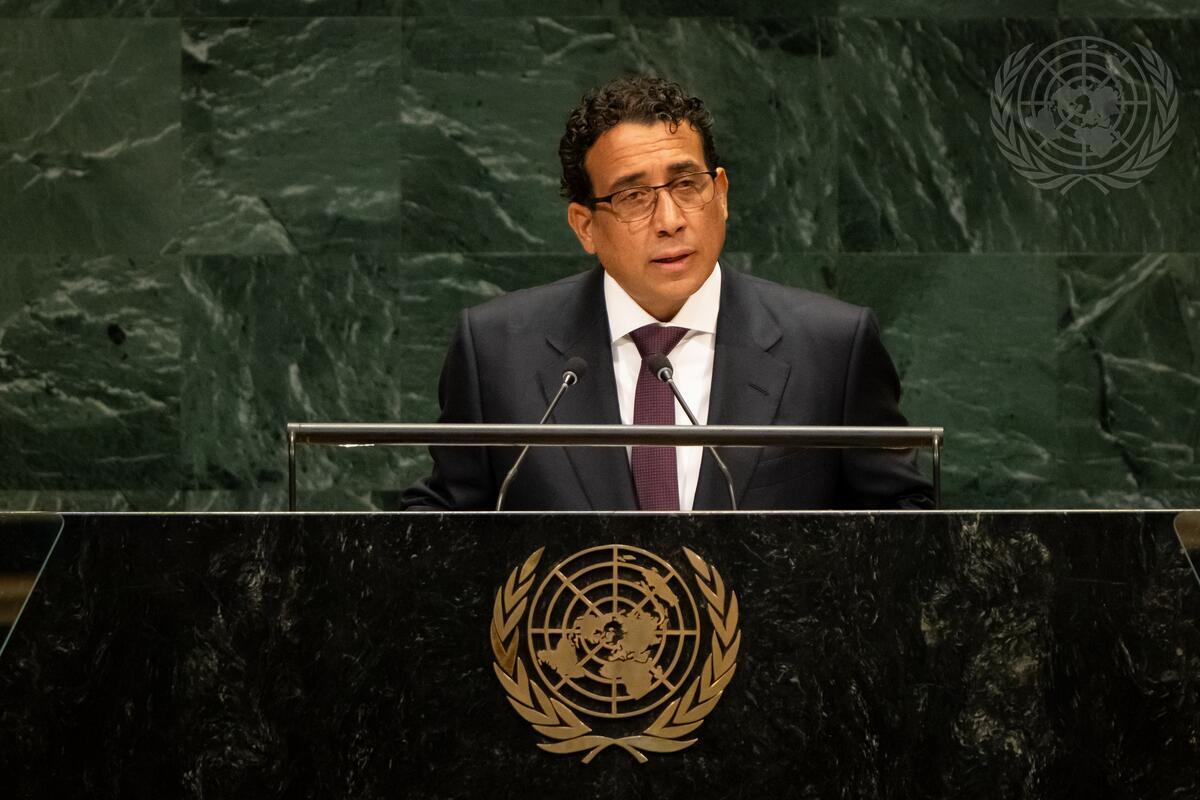

New York — September 23, 2026
General Debate of the 81st Session of the United Nations General Assembly
Unofficial Translation
Libya Statement
Delivered by H.E. Dr. Mohamed Al-Menfi, President of the Presidential Council of the State of Libya
H.E. Dr. Khalilur Rahman, President of the United Nations General Assembly,
H.E. Mr. António Guterres, Secretary-General of the United Nations,
Ladies and Gentlemen,
We meet today as the world witnesses a major transformation; not only in the balance of power, but in the very concept of power and in the ethics of its use. It is a transformation that is reshaping the meaning of security, the nature of alliances, and the ability of the international system to uphold the foundations and principles upon which, and for which, it was established.
At the heart of these transformations, a question emerges that transcends the borders of states and continents: How do we build an international order in which the rule of law is an equal right, not a privilege of the strongest? And how do we make cooperation a genuine partnership among nations, not a division of spheres of influence?
We, in our Arab and Islamic world, and in our African continent, do not view this question from the position of an observer, for we live its consequences every day.
It is a reality that unfolds before us every moment in Palestine, whose delegation, to our regret, has been unable to join us at this session, where the plight of its people continues to worsen over decades of occupation, oppression, and the alteration of identity. Despite this, they remain steadfast in their right to life and self-determination; rights guaranteed by international law and international humanitarian law without discrimination.
All of humanity longs, passionately, for international charters and resolutions to be transformed from texts and promises into reality, and for the right of the Palestinian people to their state to be realized in accordance with international law. For the continued undermining of the prospects for its establishment does not merely squander the chances of peace; it pushes the region towards a widening circle of conflict, the spread of extremism, and the search for alternatives amid major expansionist projects that go beyond occupied Palestine and extend to Syria and Lebanon.
Neither Islamic and Christian holy sites, nor civilians and civilian facilities in Palestine have been spared the scourge of this conflict, whose repercussions have extended to the Arabian Gulf, most recently what the Kingdom of Saudi Arabia has been subjected to. As we affirm our full solidarity with the Kingdom in safeguarding its security, territorial integrity, citizens, and holy sites, we reject any targeting that threatens it or endangers Islamic holy sites. The security of the Kingdom and the Gulf, given their Arab and Islamic weight, is not merely a national matter; it is a pillar of the security and stability of our region.
The continuing armed conflict in Sudan, our brotherly neighbor, has made its people victims paying an exorbitant price for a devastating war, in which interests and interventions collide, and whose effects extend beyond Sudan’s borders, endangering the security and stability of the region and the unity of its states.
Likewise, the instability in the African Sahel region exposes the integrity of its states to an existential threat, as a result of the intersection of terrorism, organized crime, poverty, climate change, displacement, and migration, and the widening scope of armed conflict there. It is no longer acceptable for the world to view this region as merely a source of resources, an arena for international competition, or a margin in global decision-making.
Africa, whose journey we have followed since the establishment of the African Union, is not the margin of the world; rather, it is one of the centers of the world to come.
Libya is not on the edge of Africa; Libya is of Africa: of its history, its security, and its future.
It was from the Libyan city of Sirte that, decades ago, an African will emerged that contributed to the founding of the African Union. This is a fact that reminds us that Libya has never been merely a bridge between Africa and the Mediterranean, but a partner in shaping the African project itself.
For this reason, we view the security of the Sahel region as part of Libya’s security and stability, and of the security and stability of the countries of the region and all our African neighbors, near and far. We view development in Africa as an investment in the shared security of Africa and its European neighborhood; not as aid provided by one party to another, or a responsibility placed on one party and not another.
We also view the Mediterranean basin not as a barrier between Africa and Europe, but as a shared space for connection. Relations among its countries should move from merely managing migration and crises to making it a bridge for development, trade, energy transition, investment, and shared security.
Ladies and Gentlemen,
Geographically and politically, Libya stands at the meeting point of these worlds: Arab in its identity and language; African in its geography, destiny, and belonging; Mediterranean in an authentic part of its culture, interests, and partnerships; and Islamic in its civilizational values that tend towards peace, security, and building bridges with its neighbors.
The multiplicity of these circles does not represent a contradiction; rather, it is a source of strength, responsibility, and opportunity.
From this geopolitical position in particular, we have learned a harsh lesson over the past years: when the state weakens, the vacuum does not remain empty. It is filled by competing interests; armed groups become active within it; crime and smuggling networks spread; illicit money seeps into it; and institutions themselves turn into arenas of struggle for influence.
At that point, the state does not merely lose part of its security; its national decision begins to lose its independence. Here, we arrive at the essence of what sovereignty means to us.
Sovereignty is not merely a flag that is raised, nor borders drawn on maps, nor slogans repeated while judicial and oversight institutions are absent from exercising their roles with independence and responsibility.
Sovereignty means that the national decision is free, and that our cooperation and integration with United Nations institutions are based on transparency, seriousness, and impartiality, away from selectivity and double standards.
Sovereignty means safeguarding the rights and dignity of the Libyan people from violations, whoever the perpetrator may be, and ensuring that no one is above the law and no one escapes accountability.
Sovereignty means that state institutions are stronger than individuals and groups, that weapons are subject to the law, and that the country’s wealth remains the property of the people, not spoils shared among parties, networks of interests, or suspicious partnerships exercising tutelage over the state.
Sovereignty means preventing corrupt money from buying influence, and preventing influence from becoming an immunity that protects corrupt money. That is a circle which, if entrenched, weakens the state from within and threatens the survival of its institutions.
In this context, we call on the Security Council to shoulder its responsibilities and follow up on the UN reports submitted to it, including the reports of the Panel of Experts on violations and cases of non-compliance, to give serious consideration to their recommendations, and to take the necessary action within the established mandates, in order to ensure the effective implementation of Council resolutions and relevant sanctions measures, without selectivity or double standards.
Documented violations must not become mere incidents that recur in reports, nor should accountability end at the limits of documentation. The authority of international law and the credibility of its institutions are measured by their ability to move from monitoring violations to holding perpetrators accountable, and from decision to implementation, for all without exception.
Sovereignty also means that the state’s foreign relations are an extension of its national interests, not an extension of others’ conflicts within it.
Mr. President,
Libya has paid a heavy price when regional and international balances turned into balances within its territory. Hence, our vision for Libya’s foreign relations is clear: we do not want to replace one influence with another, one axis with another, or one dependency with another.
We want strong relations with our Arab surroundings, particularly our neighboring countries. We want Libya to regain its natural role within its African continent. And we want a balanced strategic partnership with our Mediterranean surroundings and our regional and international sphere, according to a single rule: shared interests, mutual respect, non-interference, and respect for national sovereignty.
Libya’s true ally is not the one who searches for the strongest party within it; the true ally is the one who wants a strong Libyan state. And the true partner is not the one whose interests are tied to the continuation of division, but the one whose interest with us grows the more united, stable, and prosperous Libya becomes.
We want countries to compete in Libya over investment, reconstruction, energy, technology, and development; not to compete for influence within its institutions.
Ladies and Gentlemen,
After years of political division and polarization that have drained the state and society, Libya no longer needs more crisis management, but rather a will to end the crisis. Our goal is clear: a unified, sovereign state whose institutions derive their legitimacy from the will of its people. The path to this is a return to the people, through constitutional and legal mechanisms, referendums, and free and fair elections.
The people are the source of legitimacy, and they alone are capable of granting institutions their unity and stability; not temporary deals, nor fragile settlements that collapse whenever the balance of power shifts or loyalties change.
While we welcome the efforts and intentions of every country that sincerely seeks to end the state of political and institutional division, and appreciate the role entrusted to the United Nations Support Mission in Libya and its responsibility in facilitating the political process, past experiences compel us to be clear: any viable political process must not violate four governing principles:
First: Respect for legitimacy and the constitutional and legal frameworks in force, without circumventing them or creating political arrangements outside the established frameworks and procedures.
Second: The principle of national ownership is a red line. International mediation must not turn into tutelage, nor into the manufacturing of solutions from abroad. The will of Libyans is the foundation, and the inclusion of all the different parties, without exclusion or imposition, is the true guarantee for the sustainability of any solution.
Third: Ensuring equal opportunities among all parties, and rejecting the use of force, influence, or fait accompli to impose predetermined political outcomes.
Fourth: Commitment to transparency in understandings and agreements, defining the stages of implementation, their timeframes, and the entities responsible for them, and establishing clear mechanisms for oversight and accountability, so as to ensure outcomes that are implementable, legally sound, and capable of producing legitimate and stable institutions.
Experience has taught us that fragile settlements may begin to unravel as soon as the balance of power shifts or their outcomes emerge, and that any arrangements that ignore national legal frameworks expose themselves to challenge and dispute, and reproduce the crisis instead of ending it.
Sustainable legitimacy and lawfulness are neither created by a fait accompli nor protected by shifting balances of power; they are created by the will of the people and protected by the law.
Translating these principles into national responsibility and tangible action, we announce from this podium the launch of work on a National Committee for De-escalation and Confidence-Building. It will build on national and local initiatives, and aims to anticipate conflicts, contain escalation, prevent its recurrence, support reconciliation, and create a safe environment for the political and electoral process.
We call on all Libyan parties to engage in this framework, and we call on the United Nations and Libya’s partners to support and facilitate it, in full respect for sovereignty and national ownership.
Ladies and Gentlemen,
A Libya that regains its sovereignty and the unity of its institutions will not be a gain for Libyans alone; it will be a force for stability in its Arab world, a depth for security and development in Africa, a responsible partner in the Mediterranean, and a bridge for cooperation between North and South.
From this podium, Libya announces its candidacy for membership of the Security Council for the 2028–2029 term, for the African seat, under the theme: “Consolidating Justice for Security and Peace – Libya, a Bridge Between Nations,” and looks forward to the confidence and support of Member States for this endeavor.
This candidacy is not merely a diplomatic ambition; it embodies a national will for Libya to regain its natural role in its international surroundings and to shoulder its responsibility in maintaining international peace and security, based on a firm conviction that peace is not built solely on the absence of conflict, but on establishing justice and addressing the root causes of injustice and instability.
Libya does not seek this seat merely in pursuit of a position, but to contribute to building a more equitable international order, and to be a bridge between nations, a voice for consensus, and an active partner in peacemaking.
Hence, our message to our friends and partners is not that they abandon their interests in Libya, but that they build them with us on a firmer foundation: that their interest lies in Libya’s stability, not in the fragility of its institutions; in partnership with it, not in influence within it. And we, Libyans, bear the primary responsibility.
Patriotism is not only defending sovereignty against negative foreign interference; it is also protecting the state from corruption within, safeguarding public funds, upholding the rule of law, and placing the homeland above power and interest.
Today, Libya has an opportunity to leave the cycle of transitional phases and enter the era of the state, and to regain the role befitting its history, location, and standing among nations.
Libya does not want to be an arena on whose soil the interests of others are balanced, but a state that shapes its own balance by its own will. It does not want others to compete for influence within it, but to compete for partnership with it. That is the path we choose for Libya: a state sovereign in its decision, unified in its institutions, just among its citizens, and a partner for peace and stability in its region and the world.
That is the right of our people, our responsibility before them, and our trust towards future generations.
Peace, mercy, and blessings of God be upon you.